

McKinsey just deployed 25,000 AI agents across its firm. And for a consulting business serving 45,000 people across a thousand different problems, that might make sense.
But private equity is not consulting.
PE funds have one job: create value. And when your entire operation follows a single, repeatable lifecycle covering Sourcing, Deal Execution, Portfolio Management, and Exit, deploying thousands of disconnected agents is not a strategy. It is noise.
The firms that will win the next decade are not the ones with the most agents. They are the ones with the right system.
What Most PE Funds Get Wrong About AI
The default assumption in financial services is that more AI equals more capability. So funds pile on tools — a sourcing tool here, a diligence assistant there, a reporting dashboard somewhere else — and then wonder why none of it compounds into a real advantage.
The problem is not the tools. It is the absence of a system.
When AI agents do not share context, every insight stays trapped inside the tool that generated it. Your diligence team does not know what your sourcing team learned. Your portfolio team does not know what your deal team flagged six months ago. And by the time your exit team is making decisions, they are working with a fraction of the intelligence the fund has actually accumulated.
This is the swarm problem. And it is exactly what 25,000 standalone agents creates at scale.
Four Agents. One System. Every Stage of the Deal.
There is a better model. Four agents, each purpose-built for one stage of the investment lifecycle, designed from the ground up to share context and compound intelligence across the full cycle.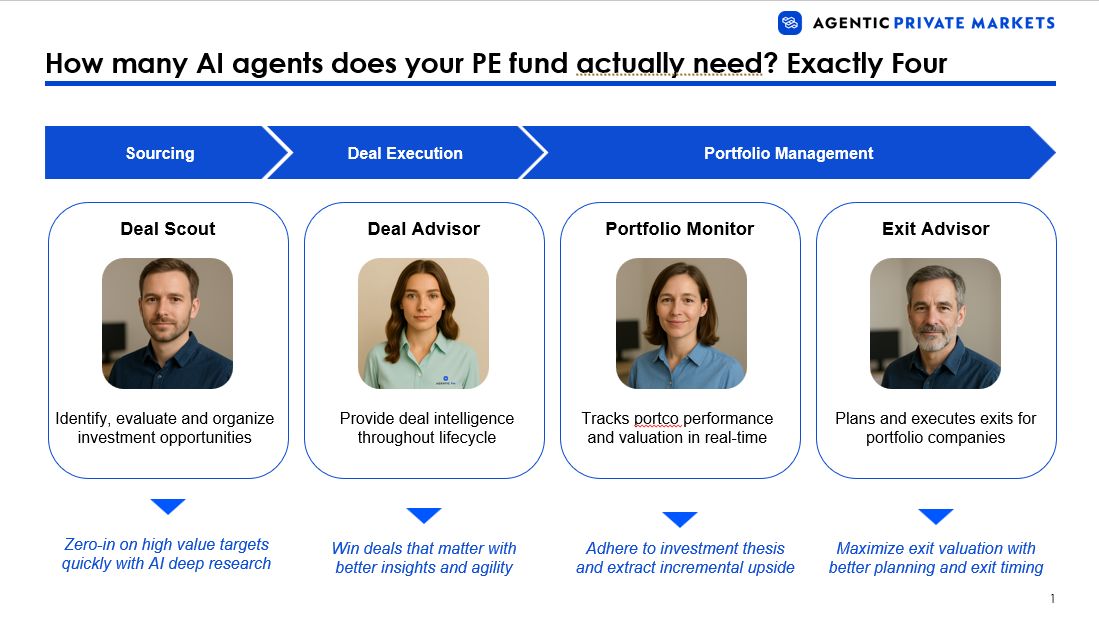
Deal Scout — Sourcing
Deal Scout identifies, evaluates, and prioritizes investment opportunities before they surface on the open market. It screens targets at scale, filtering by industry, financials, growth signals, and strategic fit, and continuously refines its criteria based on the outcomes of past deals. Your fund stops reacting to what bankers bring and starts building proprietary pipeline ahead of the market.
Deal Advisor — Deal Execution
When a target moves into diligence, Deal Advisor takes over. It synthesizes company data, market comparables, and live risk signals throughout negotiation so your team always has the most current picture, not a snapshot from three weeks ago. Deals close faster, surprises at the table become rare, and the intelligence gathered here feeds directly into how the asset is managed post-close.
Portfolio Monitor — Portfolio Management
The single most expensive mistake in PE is finding out too late. Portfolio Monitor tracks performance continuously against the original investment thesis, surfacing revenue trends, margin compression, and KPI drift early enough to act on. It flags concerns using the same thesis criteria that Deal Advisor captured at entry, turning portfolio management from a reactive exercise into a proactive discipline.
Exit Advisor — Exit Planning
Exit Advisor uses predictive analytics to model exit timing and structure, identifying when market conditions, company performance, and buyer appetite converge in your favor. Because it draws on intelligence accumulated across sourcing, diligence, and portfolio management, its recommendations are grounded in the full history of the asset and not just current market data.
Why This System Outperforms a Swarm
Each of these four agents is useful on its own. But their real power comes from how they work together.
Deal Scout learns from past exits to sharpen future sourcing criteria. Deal Advisor draws on live portfolio data to contextualize diligence risk. Portfolio Monitor uses the original investment thesis captured at entry to flag drift before it becomes a problem. Exit Advisor synthesizes everything accumulated across the entire holding period to optimize the final outcome.
The insights do not stay trapped inside individual tools. They compound. Every deal makes the next one smarter. Every exit sharpens the next entry. This is what an orchestrated system does that a swarm of 25,000 standalone agents cannot. It builds institutional intelligence over time.
The Structural Advantage Starts Now
AI adoption in private equity is not a future question. It is a present one. The funds moving now are not just becoming more efficient. They are building a compounding intelligence advantage that will be nearly impossible to close in three years.
The question for every PE leader is not whether to adopt AI. It is whether your fund will build a system or accumulate a swarm.
Four agents. One lifecycle. Every stage connected. That is the difference between AI that looks impressive in a press release and AI that actually creates value at exit.
Frequently Asked Questions
How is this different from the AI tools PE firms already use?
Most PE firms use point solutions — a tool for sourcing, another for reporting, another for diligence. These tools do not share data or context with each other, so insights stay siloed. An orchestrated four-agent system is designed so that each agent feeds the others, creating compounding intelligence across the full investment lifecycle rather than isolated efficiency gains.
Does this replace the deal team?
No. These agents work alongside your team, not instead of them. Deal Scout brings more opportunities to the table. Deal Advisor gives your team better information faster. Portfolio Monitor flags issues earlier. Exit Advisor improves timing. The decisions still belong to your people and the agents make those decisions better informed.
How long does it take to see results?
Most funds see immediate efficiency gains in sourcing and diligence within the first few months. The compounding intelligence benefit, where past deal data sharpens future decisions, builds over time and becomes a significant competitive advantage within the first year.
Is this relevant for smaller PE funds, not just large ones?
Especially for smaller funds. Larger funds have armies of analysts to compensate for information gaps. A lean fund with four orchestrated agents gets the analytical horsepower of a much larger team without the headcount.