
Most AI organizations treat them as a spectrum: fast on one end, slow on the other, staffed by roughly similar people doing roughly similar things at different speeds. That framing is wrong, and the cost of holding it shows up everywhere. Research teams measured on shipping velocity. Engineering teams asked to "explore a bit." R&D budgets that quietly evaporate because nobody could explain what success looked like.
Roberto Pieraccini has run applied research at Bell Labs, IBM, Google, and enterprise AI for decades. He wrote a sharp piece recently that names this problem directly. The framework he uses applies well beyond academic institutions. It describes exactly what is happening inside every serious AI organization right now, including the ones deploying agents into private markets workflows.
The portfolio matrix as a diagnostic
Pieraccini draws on Robert Cooper's innovation portfolio framework, which plots work on two axes: probability of technical success and expected business impact. The matrix produces four quadrants, three of which matter.
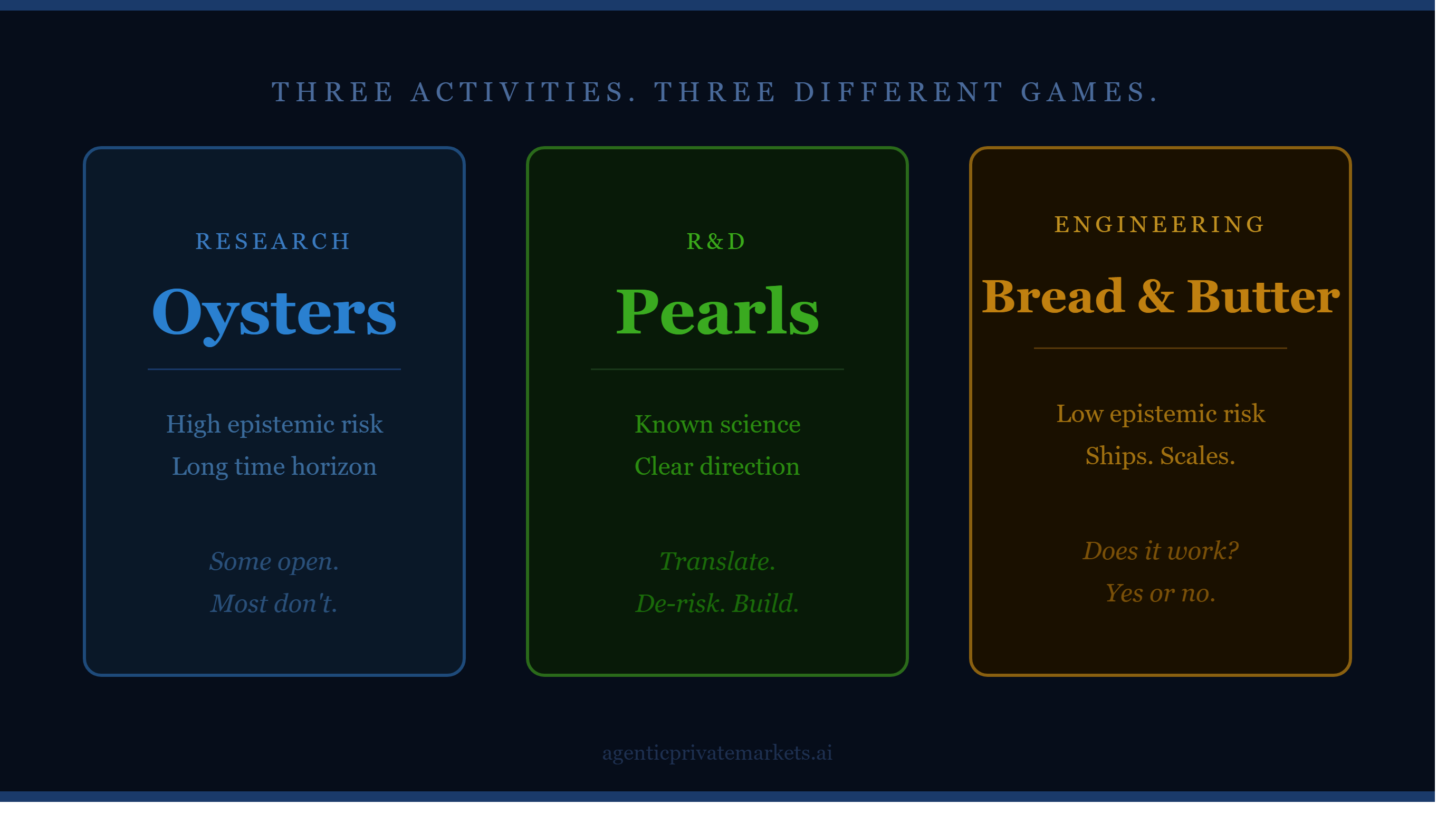
Bread and Butter is product engineering. Short time horizon, low epistemic risk, established technology turned into something reliable and shippable. Success criteria are unambiguous: does the feature ship, does it scale, are customers satisfied? This work needs excellent engineers who are comfortable operating within known constraints and optimizing within them.
Pearls are R&D programs. The knowledge base exists, the direction is clear, and high return is achievable with sustained effort. The risk is execution, not fundamental unknowns. Most frontier AI labs competing within the transformer paradigm are running Pearl-type programs. They are not doing research in the deep sense. They are translating known science into engineering-viable solutions.
Oysters are research. Long horizon, high epistemic risk, no guaranteed output. Early transformer work was an Oyster. The first large language model bets were Oysters. Current interpretability research is an Oyster. Some open; most do not. The labs currently betting that transformer-based LLMs have a fundamental capability ceiling and pursuing genuinely different architectures are running the deepest Oysters in the current AI landscape.
The fourth quadrant is White Elephants, where organizations quietly bleed. Low probability of success, low expected return. Most White Elephants started as Oysters. The failure is not launching them. The failure is not knowing when to stop. Pieraccini gives useful examples: building proprietary NLU stacks after transformers commoditized the problem; investing in voice biometrics as device-based authentication made the use case obsolete. Both looked like legitimate research bets at one point. Neither had a clear stopping criterion.
The axis the matrix leaves out
Impact and epistemic risk describe the conditions of the work. They do not describe what success looks like when the work is done.
For product engineering, success is a shipped feature. For research, it is a published paper, a new architecture, a finding that changes how the field understands a problem. R&D sits in between, and its job is translation: converting research output into something an engineering team can actually build on.
That translation work requires a specific kind of talent that is genuinely rare. Deep enough in the science to know what a research finding actually proves versus what it merely suggests. Engineering-literate enough to understand what is buildable at what cost. People who can operate credibly in both directions are not abundant. Organizations that understand this protect them. Organizations that do not tend to route them into one direction until they leave.
Why this matters for AI in private markets
The private markets context sharpens the stakes considerably.
When an investment team deploys an AI agent to source deals, screen companies, or surface signals across a fragmented information landscape, they are consuming the output of product engineering. The agent works or it does not. The workflow integrates or it does not. The failure modes are measurable and the feedback loop is short.
But the question of which agents to build, which data architectures to bet on, and which signal types will remain durable as the competitive landscape shifts are R&D and research questions. They have longer horizons, higher uncertainty, and success criteria that do not resolve in a single sprint.
Organizations that blur these categories end up with the same people answering both sets of questions, which means neither gets answered well. Research thinking applied to a product engineering problem produces overengineered solutions that do not ship. Product engineering thinking applied to a research question produces premature convergence on approaches that look locally optimal and are globally wrong.
The framework is a diagnostic. Run it against your own AI roadmap and ask which quadrant each initiative actually sits in, not which quadrant the budget presentation implies it sits in.
The gap between those two answers is where value gets destroyed quietly, and at significant scale.
AgenticPM builds AI agents for private markets deal sourcing and pipeline management. Deal Scout surfaces institutional-quality targets from fragmented data. See how it works.