

The Enterprise AI Stack Problem No One Is Owning
Remember those Capital One ads? “What’s in your wallet?”
This was a crafty question because people were carrying wads of cards—one for gas, one for groceries, one for miles, another for cash back. Different cards for different reasons, but no real strategy. And their question made people pause and think.
We are at a similar moment for AI tools. So we ask: what is in your AI stack?
Here’s what’s happening in enterprises right now: Marketing saw a YouTube video and bought Jasper—they want to move fast and break things. Engineering quietly added GitHub Copilot to the budget. Sales is running Clay pilots that IT doesn’t know about. The CIO is blocking everything because “security and compliance.” Workers are updating their resumes because they think AI is coming for their jobs.
IT’S ANARCHY SEASON AT EVERY ENTERPRISE
Too many providers, not enough clarity, and zero shared language for what AI should actually do in your organization. The result? Decision-making chaos. Governance nightmares.
When the CEO finally asks, “What’s our AI strategy?” everyone points to their favorite tools and calls it AI transformation.
The Real Issue: You Don’t Have an AI Posture
The real problem isn’t that you lack AI tools. It’s that you lack an AI posture.
You need an AI posture—not a stack of AI solutions that do not support each other. You need clear thinking and a strategy for where AI adds value to your enterprise.
One of the challenges is that you can’t build strategy without language. We use frameworks to organize our world. “Cloud vs. on-premise.” “B2B vs. B2C.” “Waterfall vs. Agile.” These aren’t just labels—they’re shared mental models that let teams make coordinated decisions.
AI needs the same clarity. The way out of anarchy is organizing what’s out there. Between sensational evangelists and apocalypse preachers, it is a Tower of Babel out there. Hence, this framework—to help you discern and decide.
Two Axes of Enterprise AI
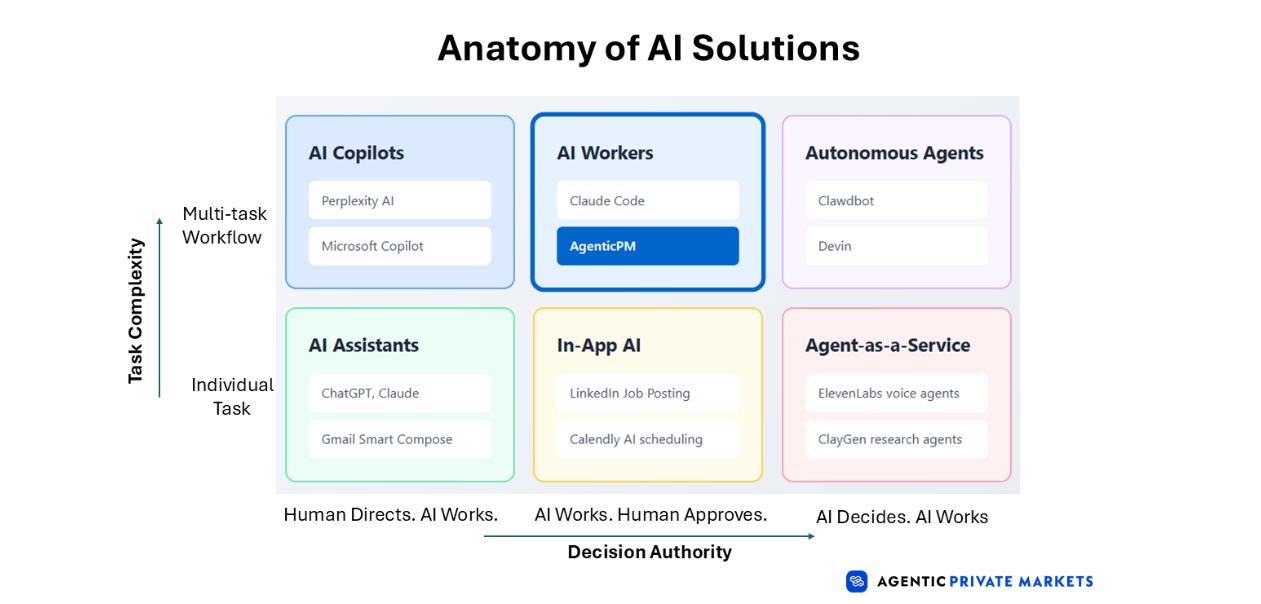
Here’s how to think about it. Every AI tool falls into one of six categories based on two questions:
- Scope of Work: Individual tasks or end-to-end workflows?
- Decision Authority: Human decides, human approves, or AI decides?
These two axes give you a simple but powerful way to classify every AI solution in your organization and see where you are over-invested, under-invested, or misaligned with your risk profile.
Category 1: AI for Individual Tasks
AI Assistants (Human Decides)
Examples: ChatGPT, Claude, Gmail Smart Compose.
These tools suggest the next action, and you manually apply it. They are good for augmenting individual productivity without changing underlying workflows. They keep humans fully in control, which makes them a low-friction entry point for most teams.
In‑App AI (Human Approves)
Examples: LinkedIn Job Posting, Calendly AI.
These are AI features embedded in tools you already use. They draft or propose; you review and publish. This is low-friction adoption—you don’t “add a new tool,” you unlock more value from existing systems while keeping an approval step.
Agent‑as‑a‑Service (AI Decides)
Examples: ElevenLabs voice agents, ClayGen research agents.
These solutions handle fully automated execution. You get the output; you’re not involved in the process. They are best suited for repeatable, low-stakes tasks, where speed and scale matter more than nuanced judgment.
Category 2: AI for End‑to‑End Workflows
AI Copilots (Human Decides)
Examples: Perplexity AI, Microsoft Copilot.
You ask; they answer. Copilots support research, analysis, and strategy work where human judgment matters more than speed. They are powerful for knowledge work but still place humans at the center of every decision.
AI Workers (Human Approves)
Examples: Claude Code, AgenticPM.
AI Workers execute multi-step workflows but check in before major decisions. They are autonomous enough to save serious time, yet supervised enough to maintain control. This is the sweet spot for most enterprises—and especially for regulated, complex domains like private markets and financial services.
Autonomous Agents (AI Decides)
Examples: Clawdbot, Devin.
You set it and forget it. These agents self-direct through complex tasks with minimal intervention. They are high leverage, high risk. Most companies aren’t ready—organizationally, technically, or from a risk and compliance standpoint—to deploy these at scale in core workflows.
AI Is a Strategic Choice, Not an Unintended Consequence
The mistake enterprises are making today: buying tools in all six quadrants without any discernible alignment on AI posture.
There is no coherent view of:
- Where AI should be allowed to make decisions
- Where it must be constrained by approvals
- Where human judgment is non‑negotiable
What is needed: you should adopt an AI posture informed by your team’s skills, enterprise risk tolerance, and operational maturity. Otherwise, AI becomes an unintended consequence of ad hoc purchasing decisions rather than a deliberate competitive advantage.
How to Define Your AI Posture
Your AI posture is the deliberate set of choices about where AI adds value, who controls it, and how it evolves with your organization. It’s not a tool list—it’s a strategic framework that answers four questions.
The Four Questions of AI Posture
- Where does AI add the most value in our business?
Which workflows are bottlenecks? Where are you losing time to coordination overhead? Where do errors cost you the most—in revenue, risk, or reputation? - What level of decision authority matches our risk tolerance?
Are you comfortable with AI making decisions autonomously, or do you need approval gates? Does this vary by function (e.g., marketing vs. compliance) or by process? - What capabilities does our team actually have?
Can your people effectively collaborate with AI Workers, or do they need to start with AI Assistants? Do you have the governance infrastructure, auditability, and incident response processes required for autonomous agents? - What’s our graduation path?
AI adoption is a journey, not a destination. Where are you today? Where do you need to be in 12 months? Which quadrants—assistants, in‑app AI, workers, agents—help you get there in a controlled, measurable way?
Example AI Postures Across Sectors
To make this concrete, here’s how different sectors might answer these questions and translate them into posture.
Professional Services: Augment First, Automate Second
(Consulting, Legal, Accounting)
- Current posture:
AI Assistants for research and drafting (Human Decides).
In‑App AI for document generation (Human Approves). - Next stage:
AI Workers for client deliverables—automated analysis with partner review before delivery. - Why:
Client work requires judgment and accountability. These firms start with augmentation, then graduate to supervised execution, preserving partner oversight while scaling analytical capacity.
Manufacturing Operations: From Optimization to Autonomous Operations
- Current posture:
In‑App AI for supply chain optimization (Human Approves).
Agent‑as‑a‑Service for predictive maintenance alerts (AI Decides). - Next stage:
Autonomous Agents for inventory reordering within defined parameters. - Why:
Operational processes are repeatable and measurable. Manufacturing can move quickly to automation where tolerance bands, SLAs, and safety thresholds are clear.
Financial Services: Automation with Non‑Negotiable Oversight
- Current posture:
AI Copilots for market research (Human Decides).
AI Workers for compliance documentation (Human Approves). - Next stage:
Stay in these quadrants. Regulatory environment demands human oversight. - Why:
In this domain, risk and compliance trump speed. Automation with approval gates is the ceiling, not a stepping stone. The posture is intentionally conservative but still leverages AI to handle documentation, monitoring, and analysis at scale.
Tech Startups: High‑Velocity AI Adoption
- Current posture:
AI Workers everywhere—code, customer support, content (Human Approves). - Next stage:
Autonomous Agents for deployment pipelines and routine customer queries (AI Decides). - Why:
For startups, speed is survival. They often have the technical talent to govern autonomous systems and a higher appetite for risk, making aggressive experimentation with agents a rational posture.
Notice what’s different in each example? The AI posture is a response to the business reality of the enterprise—its revenue model, risk profile, regulatory context, and talent base.
Why Clarity on AI Posture Beats a Bigger AI Budget
Without this clarity, you’re all over the place:
- Paying for multiple tools doing the same thing
- Leaving significant gaps in your competitive posture as AI advances
- Accumulating budget bloat with no measurable ROI
- And when something goes wrong, no one knows who was supposed to be watching
Companies that win won’t have the biggest AI budgets. They’ll have the clearest AI posture—knowing exactly what they need AI to do, who should approve it, and how to grow their capabilities over time.
The Bottom Line: Audit Your Stack, Decide Your Posture, Then Act
So: What’s in your AI stack? And more importantly—should it be?
The next step is not to buy another AI tool. It’s to audit your current stack against this framework, define your AI posture, and then align spend, governance, and implementation accordingly.
From AI Assistants to AI Workers in Private Markets
We’re building AI Workers for Private Markets that execute complex workflows with human oversight. These workers are designed for the realities of private equity and private markets: multi‑step processes, high-stakes decisions, and non‑negotiable governance.
If you’re ready to move beyond assistants and into strategic automation—where AI Workers handle the heavy lifting while your team retains control—it’s time to talk.Try for free here.