

We're now 24 months past the ChatGPT moment. The fog is clearing. Here's what's coming — and what every business leader needs to do about it.
The first wave of Generative AI was about experimentation: ChatGPT demos, internal chatbots, prompt tinkering. That wave has broken. What's building now is structural — a set of changes that will reorder enterprise software, business intelligence, and user experience as fundamentally as the cloud did 15 years ago.
These observations are grounded in for-profit business reality, not research lab speculation. Here are the four shifts that are coming into sharp focus over the next 36–60 months.
1. LLMs Will Become Core Infrastructure — Just Like the Cloud
Remember when "cloud strategy" was a differentiator? Then it became table stakes. Every serious company had to decide: AWS, Azure, or Google Cloud — and build around that choice.
LLMs are on exactly the same trajectory.
The full ecosystem — vector databases, AI agents, prompt libraries, fine-tuned models — will embed itself into every company's tech stack, sitting alongside the ERP, CRM, data warehouse, and cloud provider. It won't be optional. The question facing every technology and business leader right now is: which LLM ecosystem are you betting on?
Make that decision deliberately, because switching later is harder than it looks.
2. Installed Base Will Determine Who Wins the AI Economy
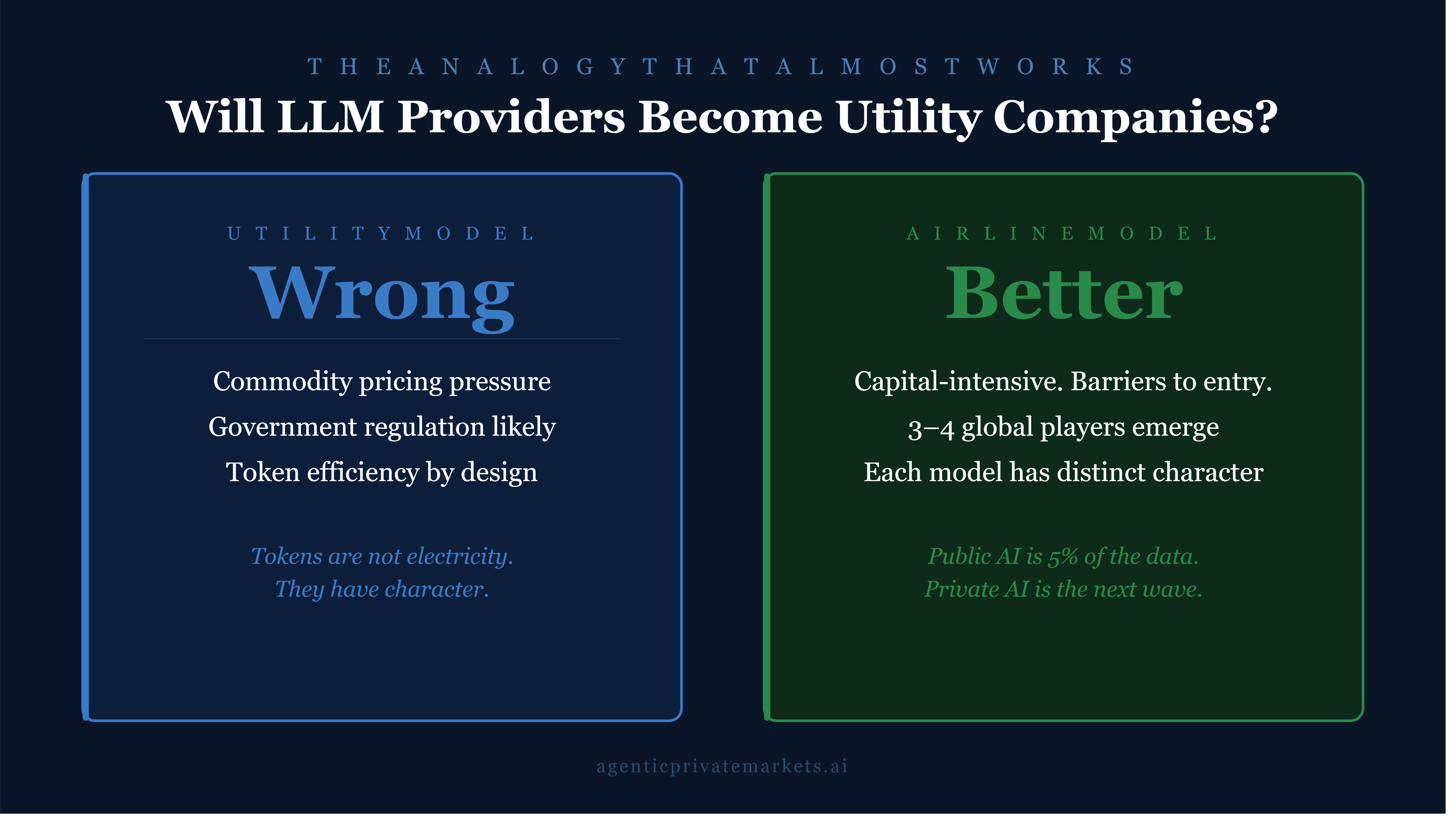
Here's a counterintuitive truth that most AI commentary misses: LLMs are not commodities, even if their pricing trends that way.
Switching between LLMs is far more painful than it appears. A single word difference in a prompt can produce dramatically different outputs across models. Enterprises that have tuned workflows, trained teams, and built integrations around one LLM develop a deep operational dependency — the same kind that keeps companies on SAP for decades despite better alternatives existing.
This means the LLM market will become an installed base war. Whoever locks in large enterprise relationships in the next 18–24 months will capture the majority of long-term GenAI value — through add-on products, services, and platform expansion. Watch this dynamic carefully. It's Oracle vs. SAP, all over again, playing out at AI speed.
3. The Click Is Dying. Natural Language Is the New UI.
Think about how interface paradigms have evolved:
- Pre-GUI era: Everything required typing
- GUI/Web era: The click dominated for 30+ years
- Now: We're watching the click begin its slow decline
Google built an empire on blue links — serve results, expect clicks. ChatGPT serves answers. That's not a product difference, it's a paradigm difference.
But look around at your enterprise software today. Every CRM, ERP, analytics tool, and workflow application is still click-first. That's about to change, and the transformation will be sweeping.
Imagine capturing a sales call summary by simply talking to your CRM instead of navigating menus in Salesforce. Imagine running a procurement approval through a chat interface while walking between meetings. Picture the AI co-pilot that surfaces the right data at the right moment without you searching for it.
Here's a provocative test for your own product teams: Which of your applications could a user operate hands-free during a 45-minute bike ride? That question reveals more about your UX debt than any usability audit.
Multi-modal interfaces — voice, image, gesture — will enable a generation of experiences that make today's click-heavy software feel as dated as a 1990s green-screen terminal.
4. Business Intelligence Will Stop Showing Data and Start Answering Questions
Eli Goldratt had it right: "Information is the answer to the question asked." Until someone asks a question, everything is just data.
Yet somehow, we built an entire BI industry around beautiful dashboards that show data in every format except the one that matters: an answer.
You've seen this pattern. A dashboard gets built, stakeholders ooh and aah, and within three months it's stale and ignored. Why? Because dashboards are designed around data availability, not decision needs.
The next generation of business intelligence will flip this completely. Instead of "here is your data, formatted nicely," the future is:
- Question-first interfaces: Users ask in natural language; the system answers
- Pyramid principle outputs: Lead with the answer, then offer unlimited drill-down into causality and predicted effects
- Proactive insight delivery: The system finds the needle in the haystack before you think to search for it
- Decision journey guidance: Users are walked through what they need to know, when they need to know it
The pretty chart won't disappear — but it will be a supporting detail, not the main event. The shift is from data presentation to decision support.
The Bottom Line
These four shifts — LLM as infrastructure, installed base lock-in, the death of the click, and intelligence that answers rather than displays — are not distant possibilities. They are unfolding right now, in different stages of maturity.
The businesses that will thrive are those making deliberate choices today: which LLM ecosystem to commit to, how to redesign workflows around natural language, and how to rebuild BI around questions rather than dashboards.
The silhouette of the next five years is visible. The question is whether you're building toward it — or waiting to react to it.