
The phrase "SaaS apocalypse" is everywhere right now. It is also wrong, but only barely, and only if SaaS companies move fast.
Here is the distinction that matters: the delivery model called SaaS will survive. The application category — Salesforce, HubSpot, Workday, ServiceNow — is under genuine pressure. Not existential pressure. Displacement pressure. And there is a meaningful difference between the two.
The Three-Layer Architecture Taking Shape
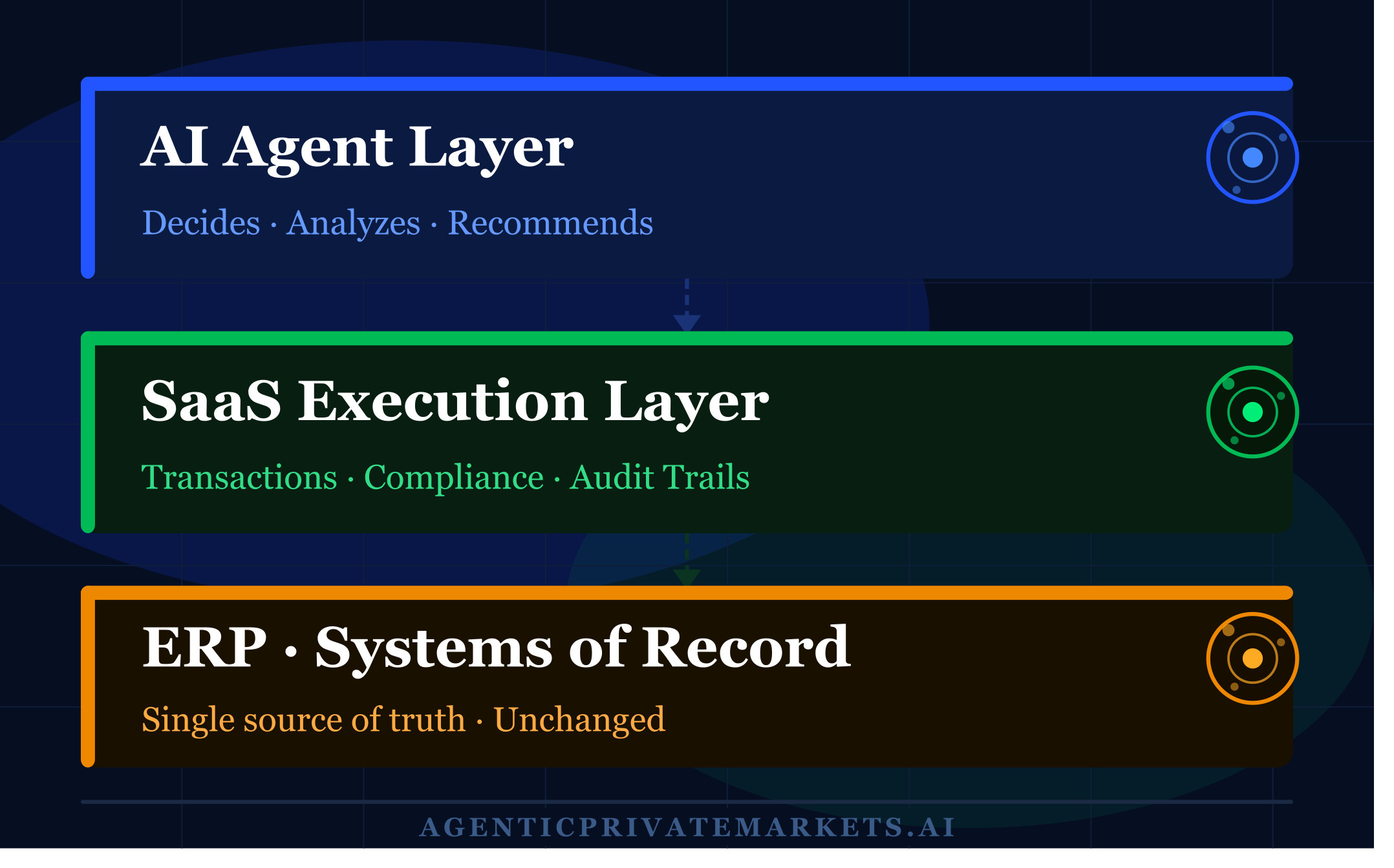
A clear consensus is forming among enterprise technology leaders on what the software stack looks like from here.
At the top sits an agentic decision layer. AI systems that converse with users, analyze patterns across large datasets, surface insights, and recommend next steps. This is where users will increasingly live. This is where work will increasingly happen.
In the middle sit evolved SaaS applications. No longer the primary interface for humans, but the reliable execution engine behind every transaction. Atomic writes. Audit trails. Compliance. The layer that does what agents instruct it to do, consistently and at scale.
At the bottom sit ERP systems and data warehouses. The single source of truth for the enterprise. Largely unchanged. Largely fine.
This is not speculation. It is the architecture that purpose-built agentic platforms are already running on today.
What This Looks Like in Practice
AgenticPM is built on exactly this model. The agents handle judgment work — deal sourcing, market analysis, decision support. They pull from Salesforce and DealCloud, enrich with live internet data, surface patterns, and recommend next steps. The human makes the final call.
The agent converses, analyzes, recommends, and triggers. But the moment a transaction requires guaranteed reliability, an atomic write, or a compliance record, that execution still runs through SaaS. Adding an employee. Creating a contract. Issuing a purchase order. SaaS handles the last mile, reliably and auditably.
Agents are decision engines, not transaction executors. The distinction is not subtle. It defines which layer owns which problem and which layer earns which dollar.
SaaS Isn't Dying. It's Being Displaced Downward.
Two decades ago, ERPs were the system of engagement. Users lived in SAP and Oracle. SaaS replaced them, took over transactional responsibility, built far better interfaces, and won decisively. ERPs got pushed down to systems of record, where they have largely remained.
History is repeating itself, one layer up.
AI agents will displace traditional SaaS applications as the primary system of engagement. Users will increasingly work through conversation and autonomous action rather than clicking through CRM pipelines or navigating multi-step workflow screens. SaaS becomes the robust execution backend it was always best suited to be.
The parallel is precise. ERPs did not disappear. They found their lane. SaaS will not disappear either. But its lane is changing, and the firms that recognize this early will be the ones positioned to benefit from it.
Three Things SaaS Companies Must Get Right
The window to adapt is not infinite. Three capabilities will determine which SaaS vendors survive the transition with commercial relevance intact.
Move from clicks to conversation. The interface paradigm is shifting faster than most product roadmaps acknowledge. Users will interact with SaaS through agents, not GUIs. Companies that have not built natural language interfaces will find agents routing around their products entirely and choosing more cooperative alternatives.
Natively enrich workflows with real-world data. Why does Salesforce rely on third-party enrichment tools to keep customer data current? Why does any CRM vendor outsource the data quality problem to Clay or a similar layer? The vendors that build enrichment natively, pulling live market data, news signals, and behavioral indicators directly into the workflow, will be dramatically more useful to agents than those that do not.
Build MCP integrations that treat agents as first-class citizens. Model Context Protocol is rapidly becoming the connective tissue of the agentic software stack. SaaS vendors that publish robust MCPs, giving agents the ability to execute transactions with the same reliability humans get today, will be the platforms agents prefer to call. Those that do not will get bypassed in favor of those that do.
The Pricing Model Will Follow the Usage Model
Per-user licensing was built for a world where humans did the work. In a world where agents handle a significant and growing portion of that work, the unit of value is no longer the seat. It is the transaction, the outcome, the completed workflow.
The migration to transaction-based or outcome-based pricing is not a theoretical future state. It is already beginning at the edges of the market, and it will accelerate sharply as agentic workloads scale across enterprise functions.
SaaS companies that hold onto seat-based pricing while agents absorb more of the work will find the model increasingly difficult to defend to both customers and investors.
The Apocalypse Is a Self-Fulfilling Prophecy
SaaS is not dying. But SaaS companies that misread the shift, that assume their user interface is their moat, that believe their workflow logic cannot be abstracted away, that treat per-seat revenue as a permanent feature of the landscape, will accelerate their own irrelevance.
The companies that adapt and become the reliable, compliant, agent-ready execution layer for the agentic enterprise will be more valuable in this new architecture than they ever were in the last one.
Apocalypse is available to anyone who chooses it.
AgenticPM's Deal Scout agent identifies investment opportunities before they surface publicly, driving origination and pipeline management through conversation and autonomous analysis. See how Deal Scout works.